
Many private equity firms approach Commercial AI by searching for a scalable, high-ROI “killer app” that can be replicated across a portfolio. The logic is understandable. If one company benefits from AI-driven training or predictive churn modeling, it is tempting to deploy the same tool everywhere. The problem isn’t that killer apps don’t work. The problem is that they work inconsistently at different portfolio companies and are often constrained by foundational gaps.
For example:
- AI targeting without a clear ICP can actually lower win rates and increase acquisition costs.
- SDR automation without a messaging strategy can create outreach fatigue and damage brand equity.
- AI forecasting built on inconsistent CRM discipline can miss revenue risk signals.
- Churn models without standardized intervention playbooks can result in uncoordinated discounting.
- Pricing tools without governance guardrails can erode margins.
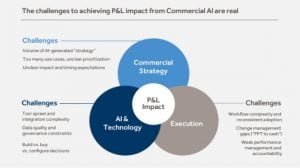
Commercial AI cannot be copied and pasted. The constraint is rarely vendor selection. It is whether the commercial system can absorb new technologies and processes and convert them into better decisions that materially enhance enterprise value. The barriers to achieving meaningful P&L impact from Commercial AI rarely exist in isolation. Most organizations struggle at the intersection where strategy, execution, and technology come together to drive consistent, measurable impact.
Although attention spans are often scarce in private equity environments, it is critically important that firms don’t rush to prioritize form over function and neglect the basics. This foundational work, such as data quality improvement, can drive breakthrough impact if not crowded out by other “high visibility” AI tools or related initiatives.
Why Commercial AI Investment Requires a Playbook
Companies need a disciplined way to allocate limited time and capital across a growing list of AI use cases. That is the role of a Commercial AI playbook. Expectations for Commercial AI investment over the next 12 to 24 months are 30% to 100% higher than all other functional areas in a company. Yet value does not arrive in steady increments. It tends to come in step changes once organizational readiness thresholds are crossed.
Enterprise value ultimately depends on improving a small number of revenue-critical decisions around targeting, conversion, pricing, retention, forecasting, and resource allocation.
A structured playbook narrows the focus of the organization before any scaling efforts. It prevents premature transformation. It clarifies which metrics must move. And, it sequences initiatives so that improvements can compound within the hold period.
With discipline, AI improves performance in the most value-creating areas. Without that discipline, AI accelerates activities that may contribute little or nothing to value creation while consuming scarce resources and bandwidth.
The Commercial AI Playbook in Practice
Drawing on our extensive experience accelerating profitable revenue growth, we have created a Commercial AI Playbook that outlines a structured, 5-step, repeatable process for answering questions such as:
- Which revenue outcomes must improve first?
- Where can AI realistically accelerate and bolster those outcomes?
- What foundational elements must be strengthened before scaling?
- How should initiatives be sequenced so value compounds inside the hold period?
It standardizes the way investment decisions are made at a portfolio level while allowing the actual initiatives to remain portfolio-specific. In practice, successful programs are roughly 80% workflow engineering and 20% technology. The playbook reflects that reality.
Step 1: Anchor on Enterprise Value
What are the biggest levers available for value creation in the commercial organization?

(Shutterstock AI Image)
Every Commercial AI journey begins with the growth model and value creation plan. Is enterprise value primarily driven by new logo acquisition? Cross-selling or upselling? Retention? Pricing realization? Seller productivity? Geographic expansion? New products? New channels?
This step forces clarity on which commercial metrics (pipeline creation, win rate, deal size, retention, or margin) must move early enough to matter inside the hold. Without this anchor, AI initiatives often multiply without meaningful impact on value creation.
Step 2: Isolate the Highest-Leverage Commercial Activities
Which commercial activities most directly affect the metrics that most need to improve?
Commercial performance is shaped by dozens of activities across sales, marketing, pricing, and customer support. Value concentrates in a small number of domains where decisions are frequent, variability is high, and outcomes materially affect revenue and EBITDA.
High-performing companies focus first where AI can most directly improve targeting precision, conversion discipline, pricing optimization, intervention actions, forecasting accuracy, or capacity allocation, identified by addressing the revenue questions below.
- Which customers, prospects, and deals should we pursue and which should we avoid?
- Which opportunities require intervention now to close, expand, retain, or deprioritize?
- How should this opportunity be advanced to maximize the likelihood and quality of a win?
- How should we price and discount each deal?
- How real is the number we are forecasting?
- Where should sales, marketing, and customer support capacity be reallocated?
Step 3: Establish Readiness Thresholds
What is required to reach the readiness inflection point where AI investments will produce measurable and significant value creation?
Enterprise-level readiness determines whether the organization can absorb and scale AI. It includes data architecture, governance, change management capability, and performance management rigor.

(Mungkhood Studio/Shutterstock)
The level of AI readiness determines whether AI will meaningfully change decisions within a specific activity area. For example, within opportunity & deal management, readiness means having defined pipeline stages and a regular pipeline review cadence. For pricing, it means having transaction-level price and cost data and a willingness to tighten discounting governance. For retention, it means having digitized contract data, clear ownership, accountability, and early warning signals that spark action.
Readiness does not require perfection. It requires usable data, defined workflows, clear ownership, and leaders that are willing to enforce discipline.
Step 4: Redesign Workflows Before Embedding AI
How must workflows and decision making be changed to significantly improve the most important metrics?
Commercial AI requires clear structure on workflows and how decisions are made – simplicity is critical. Leadership teams must clarify what decisions occur, who owns them, what criteria guide them, and how trade-offs are evaluated. Only then should AI be introduced to prioritize effort, identify surface patterns, predict outcomes, or automate execution.
For example, in a healthcare services company with a route-based sales model, sellers previously planned visits manually, captured unstructured notes, and lacked visibility into how time was spent across accounts. The redesigned workflow integrated AI-driven route planning, geo-tracking, and structured note dictation to guide daily account prioritization, capture consistent visit data, and generate insights managers could use to improve coverage and performance.
Step 5: Sequence Initiatives to Pull the Value Inflection Point Forward
How do we ensure value arrives early enough to compound, particularly within the sponsor’s hold period? Commercial AI initiatives typically fall into three categories: foundational capability building, AI-enabled workflow enhancement, and AI-native transformation.
Many organizations attempt all three at once. High-performing firms sequence deliberately. They first strengthen foundations to cross readiness thresholds. They then embed AI within disciplined workflows. Only after execution discipline is established do they pursue AI-native transformation. Sequencing converts potential into timing advantage. If this approach isn’t taken, AI investments might ultimately deliver value, but too late to capture at exit.
From Possibility to Execution
Commercial AI creates meaningful value when leaders decide what must change first and then sequence actions and investments so that improvements compound year over year. The difference between isolated tools and engineered value creation is not model sophistication – it is focus, discipline, and timing.
The right actions will vary by growth model, industry dynamics, revenue mix, and economic constraints. A new account-driven industrial manufacturer will sequence AI actions and investments differently than a margin-constrained distributor. An expansion-led healthcare services provider will prioritize differently than a project-based professional services firm.

(Wanan Wanan/Shutterstock)
The Commercial AI Playbook provides a consistent process to select the best actions for each individual company, regardless of industry. When Commercial AI is approached this way, the work shifts from experimentation to execution. Trade-offs become explicit. The path from AI activity to measurable enterprise value becomes shorter and more predictable.
The difference between spreading effort across multiple tools and concentrating on the highest- impact revenue drivers can translate into tens or hundreds of millions in enterprise value. As Commercial AI investment accelerates, organizations that apply a structured, decision-led approach will separate from those that generate activity without impact.
About the author: Chris Heuschkel is a Managing Director and the Chief AI Officer at Blue Ridge Partners. With 25 years of consulting and operating experience, he focuses on leveraging data, AI/ML, and technology to drive revenue growth and value creation. He has worked with over 30 leading Private Equity firms and hundreds of companies as a strategic advisor and has held various.
If you want to read more stories like this and stay ahead of the curve in data and AI, subscribe to BigDataWire and follow us on LinkedIn. We deliver the insights, reporting, and breakthroughs that define the next era of technology.
The post The Commercial AI Playbook: A 5-Step Framework for Prioritizing AI Investments That Drive Enterprise Value appeared first on BigDATAwire.
Go to Source
Author: Chris Heuschkel