

Artificial intelligence has dazzled us with conversation. The real revolution is underway, one where AI doesn’t just talk, but acts.
Across large organizations, a new class of AI-native assistants is quietly reshaping workflows. These systems go beyond chat; they take action. They process claims, open support tickets, reroute supply chains, and even draft contracts, all while operating under human supervision. They are fast, tireless, and increasingly capable of navigating enterprise logic.
We have had automation for decades. This is a new layer of autonomy. AI agents can plan, reason, and act with awareness of context. They can move information between systems, make low-risk decisions, and document every step they take. This shift promises to close one of the biggest gaps in business today: the long delay between deciding to act and actually acting.
Closing the Automation Gap
Every organization wrestles with the workflow abyss. You submit a form or a report, it disappears into a process, and at some point, an answer appears with little explanation. Rules and scripts handle the simple cases, while exceptions wait in queues for humans to review.
(Shutterstock AI Image)
AI agents change that rhythm. They bring memory, structured reasoning, and end-to-end execution to the enterprise. Instead of waiting days, a process can finish in hours. The benefits are both speed and consistency. Each step is logged, each decision can be explained, and the outcome aligns with policy.
Rather than autopilot, think of a control tower. Each agent operates in its lane, governed by strict rules and coordinated with others. Humans still set the priorities and handle anything unusual, but the handoffs become instant and traceable.
From Demos to Decisions
For years, business leaders saw AI demonstrations that looked impressive but were impossible to deploy safely. Beyond smarter models, the turning point was realizing that safety, not flash, unlocks real enterprise value.
Modern AI agents can act inside enterprise systems, while recording exactly what they did and why. They operate with least-privilege access and policy-as-code guardrails, ensuring compliance and transparency. The combination of intelligence and accountability has finally made automation suitable for regulated environments.

(Mooam/Shuttestock)
That distinction matters. No agent should go live unless it can explain its actions, prove value, and be reversed if needed. An irreversible decision isn’t innovation; it’s an unmanaged risk.
Learning to Trust Machines
The best mental model for understanding an AI agent is to imagine a talented intern with perfect recall. You give the intern clear instructions, boundaries, and oversight. They learn quickly, keep records of their work, and ask questions when something looks unusual.
Over time, if they perform well, you scale them up. If not, you scale them back. Trust is gradual and earned through measured performance, not assumption. The same is true for AI.

(Vitamin444/Shutterstock)
Enterprises that follow this model build reliable systems. Those that skip it often learn painful lessons. Microsoft’s chatbot Tay in 2016 is a cautionary tale, learning from social media without proper guardrails led to instant failure. The problem was not intelligence; it was a lack of control. Safe automation builds confidence one step at a time, starting small and scaling only after trust is earned.
The Case for “Boring AI”
The AI that gets headlines writes songs or drives cars, but the AI that creates the most value performs ordinary work, quietly and reliably. It reconciles invoices, validates data, and matches transactions. These are not glamorous tasks, but they are the backbone of business operations.
We have found that careful and predictable automation scales faster than risky innovation. Every successful deployment starts with low-stakes work, detailed logging, and tested rollback plans. When a system proves it can perform these reliably, then it can move on to more complex decisions. Trust is earned through repetition, traceability and outcomes, not rhetoric.
A New Division of Labor
As AI agents mature, a new balance is emerging between humans and machines. People bring judgment, empathy, and strategic thinking, while agents take on volume, structure, and routine. This shift does not remove people from the loop; it allows them to spend more time on the work that requires human context and creativity.
(Credits:promethium.ai)
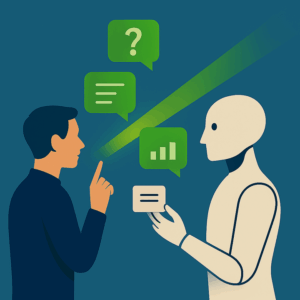
Some organizations are going further by building networks of specialized AI agents that collaborate. One agent gathers data, another analyzes it, a third checks compliance, and a fourth writes the summary for review. It’s not one generalist machine. It’s an orchestration of specialists, each executing a defined role in harmony.
The payoff is not only speed but clarity. When each agent has a defined role, the system is easier to audit and explain.
Safety as a Strategy
In today’s environment, good governance is not a brake on innovation. It is the foundation that makes sustained innovation possible. The most successful AI programs treat safety features not as a checkpoint, but as a product feature. The capability to trace decisions, roll them back, and prove compliance is what allows companies to move fast without losing trust.
We believe every agent must pass four tests before going live: quality, safety, control, and measurable value. If it fails one, it does not launch. That consistency allows teams, regulators, and customers to have confidence in the outcome.
Safety is not the opposite of speed. It is the reason speed is sustainable.
The Human Equation
AI agents are not replacing people. They are replacing the waiting between decisions.
 The most effective systems do not remove human oversight. They remove friction so that human expertise can matter more. By automating the predictable, they make space for judgment, empathy, and strategy.
The organizations that succeed in this new era will not be the ones that experiment the fastest. They will be the ones that scale carefully, measure continuously, and explain every choice their systems make.
Trust is the invisible infrastructure of automation. It is built with evidence, earned over time, and strengthened each time a decision can be explained.
About the Author: Jack Yu is Director of Product Management – Generative AI at Experian, where he leads enterprise AI strategy and innovation within the Experian Innovation Lab. He is responsible for advancing the development and responsible deployment of generative AI and machine learning solutions across fraud prevention, compliance, identity, and data intelligence platforms serving global financial institutions and enterprises.
If you want to read more stories like this and stay ahead of the curve in data and AI, subscribe to BigDataWire and follow us on LinkedIn. We deliver the insights, reporting, and breakthroughs that define the next era of technology.
The post AI-Native Assistants Have Arrived—But Earning Trust Is the True Innovation appeared first on BigDATAwire.
Go to Source
Author: Jack Yu