

Artificial intelligence has moved from the research lab into the boardroom, the data center and virtually every business function in between. Nearly 80 percent of organizations now use AI in at least one core business process, according to McKinsey, yet widespread adoption has surfaced a persistent problem: a deep shortage of professionals who can translate AI tools into measurable business results. That gap is driving extraordinary interest in AI certifications, and for good reason. The question most IT professionals are asking is not whether AI skills matter, but which credentials deliver the greatest return on investment.
The AI job market has responded accordingly. AI and machine learning hiring grew 88 percent year-over-year in 2025, according to Ravio’s 2026 Compensation Trends report, while administrative role hiring simultaneously dropped 35 percent. This is not a niche trend. Dice.com reports that approximately 36 percent of tech job postings now require AI skills, with major consulting firms such as Deloitte, Accenture, PwC and KPMG among the top 25 AI hirers in the United States. The window for early movers is open, but it will not remain so indefinitely.
The most valuable AI certifications for business
Not all AI credentials carry equal weight with employers. The certifications that consistently appear in job postings, command hiring manager attention and translate into measurable salary gains share a few common characteristics: they come from recognized vendors or institutions, require hands-on project work and address real-world business problems rather than theoretical exercises alone. The following credentials rank among the most valuable for professionals entering or advancing within AI-focused roles.
Google Professional Machine Learning Engineer
This certification is widely considered one of the highest-value credentials available for professionals working with cloud-based machine learning systems. At a $200 exam fee, it requires three to five months of focused preparation for most candidates, though experienced engineers sometimes complete preparation in under 30 days. Holders report average salaries near $130,318, and professionals already working in data or engineering roles frequently cite a salary bump of approximately 25 percent following certification, according to community data compiled by Nucamp. Google and AWS certifications appeared in 40 percent more job postings than competing credentials, with demand increasing 21 percent year-over-year, according to an analysis of more than 15,000 job postings from Q4 2025 through Q1 2026 published by Skillupgradehub.
AWS Machine Learning Specialty
Amazon Web Services offers one of the most employer-recognized AI credentials for professionals working in enterprise environments. The $300 exam assumes substantial hands-on experience with Amazon SageMaker and the broader AWS data stack, and most candidates invest four to six months in preparation. Hiring surveys consistently associate this certification with roughly a 20 percent salary boost in existing data and engineering roles, particularly within organizations that have standardized on AWS infrastructure, according to Nucamp’s certification ROI analysis.
Microsoft Certified: Azure AI Engineer Associate (AI-102)
For professionals operating within Microsoft-centric enterprises, the Azure AI Engineer Associate certification validates the ability to build and deploy AI solutions using Azure Cognitive Services, Azure Machine Learning and related tools. The exam costs approximately $165, and study typically requires three to six months. DigitalOcean’s 2025 analysis of top AI credentials lists this certification among the most recognized across Microsoft ecosystem environments, which represent a large share of the enterprise market.
IBM AI Developer Professional Certificate
IBM’s professional certificate program, available through Coursera for approximately $49 per month, functions as a comprehensive entry point for professionals transitioning into AI roles. The program covers machine learning, prompt engineering, data analysis, neural networks, Python libraries and deploying large language models. IBM refreshed the generative AI content in March 2025, keeping the curriculum current with production-grade techniques. For career changers, the ROI can be dramatic. Skillupgradehub’s 2026 analysis documents cases in which professionals moved from $52,000 salaries to $78,000 AI engineering positions following completion of this program.
PMI AI+ Certification
Launched in 2025 after PMI acquired Cognilytica, the PMI AI+ is the first major project management credential specifically designed for AI initiatives. It targets project managers, program managers, product owners and scrum masters who lead or support AI deployments. A distinctive feature is that preparation earns candidates 21 PDUs toward other PMI certifications, covering more than a third of PMP renewal requirements. Unlike most credentials in this space, it currently carries no expiration date, eliminating ongoing renewal fees. For business-side leaders who need credibility when overseeing AI programs without building models themselves, this certification fills a critical gap, according to Dataquest’s 2026 certification guide.
NVIDIA Deep Learning Institute Certifications
NVIDIA’s credential portfolio addresses advanced technical roles focused on computer vision, GPU optimization and deep learning model development. Costs vary by course, ranging from $2,500 to $4,700 per course, with a $325 application fee and a requirement to complete 16 or more days of coursework within 36 months. DigitalOcean lists NVIDIA credentials among the most recognized for highly specialized technical positions where deep learning and GPU-accelerated computing are central to the role.
The salary impact: What the data shows
The financial case for AI certification is compelling, though professionals should approach salary estimates with realistic expectations. The gains are real, but they vary significantly based on prior experience, role type, geographic market and the specific certification earned.
According to Payscale data cited by Dumpsgate, the average salary of a certified AI professional in the United States is approximately $144,000. Entry-level roles typically begin around $80,000, while experienced practitioners can reach $162,000 or more. Glassdoor data, reported by Coursera in February 2026, shows median total base pay ranging from $99,578 for AI researchers to $134,188 for AI engineers.
Certified AI professionals earn between 23 and 47 percent more than their non-certified peers in 2026, according to salary analysis by Skillupgradehub drawn from more than 10,000 job postings. PassItExams research documents that AI-certified professionals command salary premiums reaching 47 percent above non-certified peers in some roles. However, Ravio’s 2026 Compensation Trends report provides a more moderate benchmark from actual payroll data: AI and ML roles command a 12 percent salary premium at the Professional/Individual Contributor level and a 3 percent premium at the Management level compared to non-AI roles. The smaller premium for managers reflects employer emphasis on hands-on contributors who can directly integrate AI into workflows.
For specific certifications, estimated salary impacts include the following ranges. The Google Professional Machine Learning Engineer is associated with a target salary of approximately $130,318 and a 25 percent bump for data and engineering professionals. The AWS Machine Learning Specialty carries a target salary range of roughly $120,000 to $155,000 and a 20 percent boost for existing practitioners. Entry-level credentials such as the IBM AI Developer program can produce career transitions that lift salaries from the $65,000 to $75,000 range into the $90,000 to $115,000 range for junior AI engineering roles. Data engineers who add AI capabilities through specialized credentials command 25 to 35 percent salary premiums over traditional data engineering peers, according to PassItExams.
Indeed data indicates that generative AI skills specifically can boost salaries by as much as 47 percent, cited by USAII, reflecting employer urgency around LLM deployment skills that remain scarce in the market.
The pros: Why AI certifications deliver real value
The business case for AI certification extends well beyond salary projections. Pearson VUE’s 2025 Value of IT Certification Candidate Report, based on survey responses from nearly 24,000 IT professionals globally, documented organizational impacts that go directly to the bottom line.
- Quality improvement: 79 percent of certified respondents reported a better quality of work output following certification.
- Innovation: 76 percent reported an increased ability to innovate and enhance work processes and outcomes.
- Productivity: 70 percent reported greater on-the-job productivity.
- Career advancement: 82 percent of respondents gained concrete career benefits, including promotions, salary increases and expanded responsibilities.
- Lifelong learning signal: 84 percent of certified professionals planned to pursue another IT certification within 12 months.
For hiring managers, certifications from recognized vendors and institutions function as trusted quality signals in a market flooded with self-reported AI experience. LinkedIn research highlights that candidates listing well-known certifications see higher recruiter engagement compared to those without them, according to DigitalDefynd’s 2026 analysis of AI certification value.
Certifications also address a structural problem that employers cite repeatedly. While 79 percent of organizations now use AI, DigitalOcean’s 2025 Currents report found that 41 percent struggle to integrate AI into existing workflows, 35 percent face challenges in model selection and 30 percent navigate data privacy minefields. Certified professionals are specifically trained to solve these problems, which is why demand for them consistently outpaces supply.
The cons: Limitations and honest cautions
AI certifications are valuable tools, but they are not magic credentials. Professionals and employers alike should understand their limitations before making significant investments.
- Time commitment is substantial: Comprehensive AI certification programs frequently require 10 to 15 hours of study per week over several months. For full-time professionals, this means evenings and weekends dedicated to coursework. Coursera’s Global Skills Report and Statista both rank time constraints among the top three barriers to professional upskilling.
- Cost can be prohibitive: Exam fees range from approximately $100 for entry-level credentials to $8,780 for multi-day intensive programs. Premium programs through institutions such as MIT Sloan can reach $2,500 to $4,700 per course. Not all employers reimburse these costs upfront, creating a financial barrier for some professionals.
- No universal accreditation standard: Unlike regulated professions such as law or medicine, AI certifications remain largely market-driven. Two programs with similar titles may differ dramatically in academic depth and practical rigor. This creates information asymmetry that forces learners to do careful due diligence before committing time and money.
- Experience still matters most: Employer surveys consistently show that hiring decisions prioritize experience, problem-solving ability and demonstrated business impact over certifications alone, according to LinkedIn and McKinsey data cited by DigitalDefynd. One hiring manager quoted by The Interview Guys put it plainly: ‘We are desperate for people who actually understand RAG architecture, not just people who have used it through an API.’
- Rapid obsolescence risk: AI technology evolves faster than most certification bodies can update their curricula. A credential earned in 2023 may reflect concepts that have already been superseded by newer techniques. Professionals should prioritize programs with documented update cycles and verify content currency before enrolling.
- Theory-practice gap: Programs that lack hands-on labs, capstone projects or real-world datasets can leave learners with theoretical knowledge that does not transfer to production environments. Without applied components, certification may signal effort without demonstrating actual capability.
Choosing the right credential for your role
The best AI certification depends on where a professional is starting and where they want to go. DigitalOcean outlines a practical decision framework: consider your technical foundation, your time and financial investment capacity, the industry recognition of the credential and your specific career trajectory.
For hands-on technical roles such as machine learning engineer, data scientist or AI engineer, vendor certifications from Google, AWS, Microsoft or NVIDIA carry the greatest market weight. For business leaders, product managers and project managers who need to speak credibly about AI without building models, credentials such as the PMI AI+ or IBM’s business-focused programs provide a more appropriate entry point. Andrew Ng’s AI for Everyone, offered through Coursera, remains one of the most effective programs for non-technical professionals who need AI literacy without programming requirements, completing the program in under ten hours.
For cybersecurity professionals specifically, the AI security credential landscape is expanding rapidly. AI security roles are paying between $180,000 and $280,000 in 2026, according to Practical DevSecOps, driven by demand for professionals who can secure LLM deployments, prevent prompt injection attacks and lock down AI pipelines. Specialized credentials such as the Certified AI Security Professional carry a salary premium of 15 to 20 percent over peers holding only generalist security certifications.
AI certification learning path: Beginner to expert
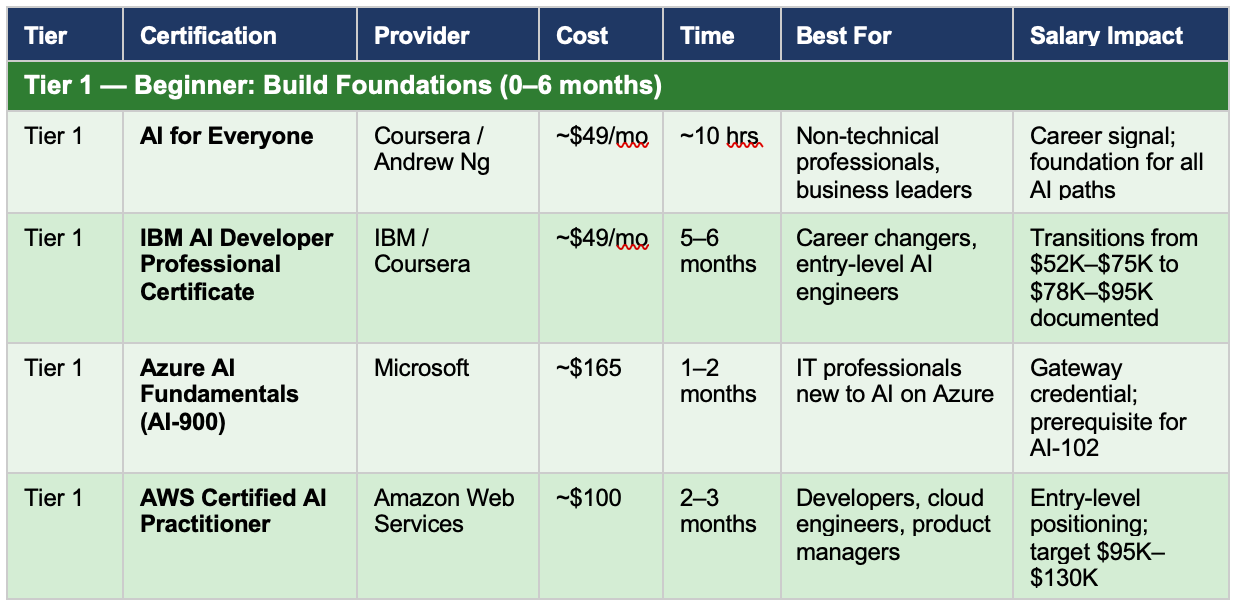
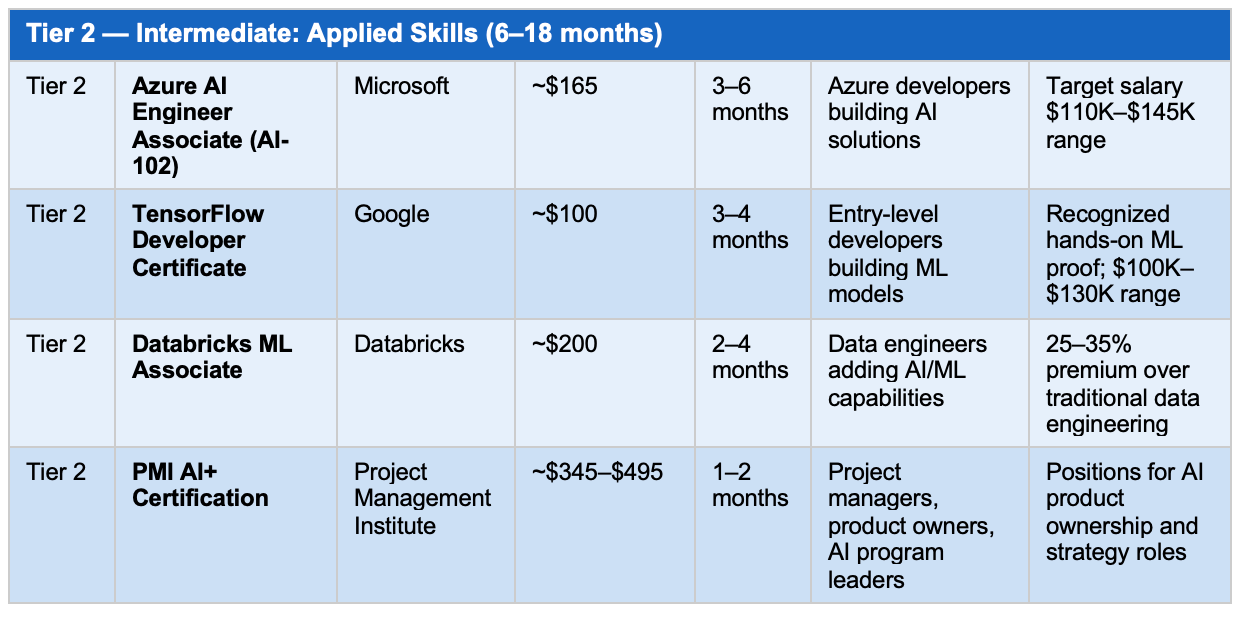
Here is a learning path you can explore, with each tier showing the certifications, typical timeframe and cost estimates. The path is built around four tiers that map to experience level rather than time in tech, so someone coming from a non-technical background can still progress through it systematically.
Tier 1 is about AI literacy and foundational awareness. Andrew Ng’s AI for Everyone is the fastest on-ramp for business professionals, while the IBM AI Developer and cloud foundational certs (AWS AI Practitioner, Azure AI-900) begin building hands-on vocabulary. These do not require prior coding experience.
Paul Frenken
Tier 2 moves into applied skills, where professionals start building and deploying real solutions. The Microsoft AI-102 and TensorFlow Developer credentials are natural follow-ons for cloud engineers and developers. The PMI AI+ is the right branch for project managers and business leaders who want to lead AI initiatives rather than build them.
Paul Frenken
Tier 3 is where serious salary premiums kick in. The Google Professional ML Engineer and AWS ML Specialty are the two most employer-recognized advanced credentials and are tied to documented 20–25% salary bumps for professionals already working in data and engineering roles.
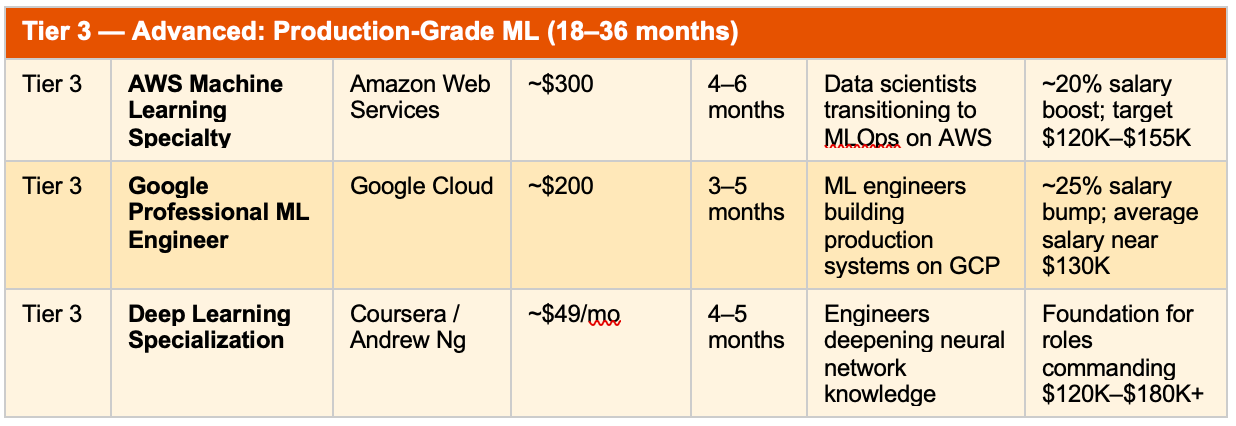
Paul Frenken
Tier 4 represents specialization tracks rather than a single next step. NVIDIA’s DLI targets computer vision and GPU-intensive work, the CAISP is the path for cybersecurity professionals pivoting into AI security and Stanford’s graduate certificate is the academic credentialing route for those targeting research leadership or senior advisory roles.
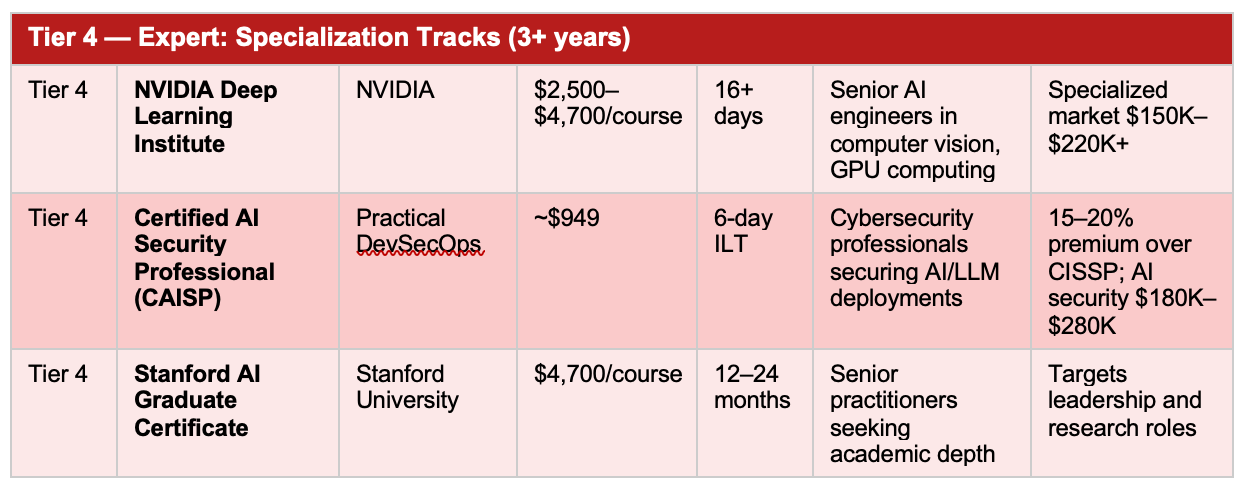
Paul Frenken
Note: The salary figures in the tables above are based on 2025–2026 market data from Glassdoor, Indeed, Payscale, PassItExams and Ravio. Individual outcomes vary by location, experience and employer. Costs reflect exam fees unless otherwise noted.
The bottom line
AI certifications represent one of the highest-return professional investments available to IT professionals in 2026. The market is generating enormous demand, the skills gap remains wide and salary data consistently confirms that certified professionals out-earn their non-certified counterparts. For entry-level professionals, the right credential can produce a $20,000 to $30,000 salary lift within the first year. For experienced practitioners adding AI specialization to an existing technical foundation, gains of 20 to 47 percent above current compensation are well-documented in the literature.
The cautions are real. Certification alone will not substitute for demonstrated experience, hands-on project work and business acumen. The best candidates combine credentials with portfolios, practical skills and the ability to translate AI capabilities into organizational outcomes. For professionals willing to make the investment, the question is not whether AI certification is worth it. The data answers that plainly. The real question is which credential best positions you for the role you are targeting, and whether you are prepared to back it up with the practical skills that employers are urgently seeking.
This article is published as part of the Foundry Expert Contributor Network.
Want to join?
Go to Source
Author: