
When you think of the global AI race, what comes to mind? Models, benchmarks, and faster training? Well, those still matter, but the race depends more on infrastructure – think data centers and power grids.
While many countries are investing heavily in this space and are slowly catching up in the AI race, the U.S. and China remain ahead. The U.S. still leads in frontier models and advanced compute. China continues to scale the physical foundations needed to deploy AI at scale. Between them, they greatly influence how the global AI infrastructure takes shape.
How the U.S.–China AI Race Reached This Point
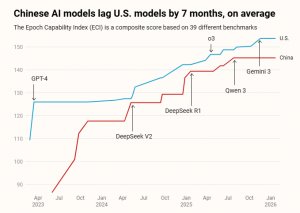
Most of the early chapters of the global AI race were written in model releases. As LLMs became more widely adopted, labs in the U.S. moved fast. They had support from big cloud companies and investors. They trained larger models and chased better results. For a while, progress meant one thing. Build bigger models, and get stronger output. That approach helped the U.S. move ahead at the frontier.
Chart: Nikita Ostrovsky for TIMESource: Epoch AIGet the dataCreated with Datawrapper
However, China had other plans. Their progress may not have been as visible or flashy, but they quietly expanded AI research across universities and domestic companies. They steadily introduced machine learning into various industries and public sector systems. With both countries racing to build larger, the competition during this phase mostly stayed focused on algorithms and to some extent – talent.
That model-first era began to fade when semiconductor supply chains entered the picture. The export controls set by the U.S. curtailed China’s access to advanced GPUs – a vital requirement for compute. It forced a rethink of how AI systems could be trained and deployed. Some viewed this move as a rather short-term fix. They argued that this could force China to develop better in-house capabilities in the long run.
That is exactly how China responded. They accelerated domestic chip efforts and ramped up investment in data centers and energy infrastructure. It was a clear change of strategy – less emphasis on chasing frontier releases, and more on building deployment capacity.
At the same time, something happened in China that sent shockwaves through the world, including tech companies in the West. DeepSeek burst out of nowhere to show how AI model performance may not be as contrained by hardware as many of us thought.
This completely reshaped assumptions about what it takes to compete in the AI race. So, instead of being dependent on scale, Chinese teams increasingly focused on efficiency and practical deployment. Did powerful AI really need powerful hardware? Well, some experts thought DeepSeek developers were not being completely transparent on the methods used to develop it. However, there is no doubt that the emergence of DeepSeek created immense hype.
It was around that time that the competition had begun to move away from models alone. The pressures of hardware access, energy availability, and deployment at scale were starting to become critical factors in overall AI success. And that changed how both countries approached AI.
Where the U.S.–China AI Race Stands Today
The AI race isn’t defined by a single measure. Instead, it is defined by a distribution of strengths across different pillars.
Let’s start with frontier capability and compute access. Most of the world’s highest-performing AI models still come from the U.S. Sure, that advantage reflects deeper access to advanced hardware. But it also shows much stronger ties to hyperscalers and sustained private investment. The result is leadership in benchmark performance and early deployment of cutting-edge systems. On that chart, the U.S. remains ahead.

Chart: Nikita Ostrovsky for TIMESource: Ember (2026); Energy Institute – Statistical Review of World Energy (2025) – with major processing by Our World in DataGet the dataCreated with Datawrapper
When you look at metrics tied to scale, it changes the picture slightly. In energy capacity and domestic researcher output, China either matches or exceeds the levels in the U.S. This may surprise some, but it shows that China’s industrial base supports faster physical buildout. Also, its education system is better tuned to support a larger supply of technical talent.
This data points to a more nuanced reality than headline narratives often suggest. This isn’t a race where one side dominates every category. Instead, each country leads in areas aligned with its broader economic and political structure.
The U.S. excels at frontier innovation. China excels at expansion and deployment at scale.
The Chinese government may also have greater control over AI’s progress in the private sector. We are seeing more Western governments wanting to play a bigger role, and possibly have more control of AI’s evolution in their countries.
It’s also important to keep in mind that a lead in model performance doesn’t automatically translate into leadership in AI adoption. Just like how strength in infrastructure doesn’t guarantee breakthroughs at the cutting edge.
What we are seeing instead is a multi-axis competition. The progress depends on how effectively each side uses its advantages and is able to connect research, hardware, energy, and operations.
When AI Became an Infrastructure Problem
There was no single turning point for the emergence of the infrastructure problem. Many things happened over time. The GPU access tightened. The cloud regions reached capacity. Enterprises discovered that compute was no longer flexible. AI became something you schedule, not something you simply spin up. This affected every layer of the stack.
Startups optimized because they had to. Large companies locked in multiyear contracts to secure supply. The roadmaps shifted to match availability, and even the most well-funded projects slowed when capacity ran out.

(Shuttestock AI Image)
Then came the next big limiting factor – power. As we have covered on BigDATAwire, energy shortage is a major concern. Training and inference clusters now require massive energy inputs. New data centers depend on grid upgrades. With transmission delays slowing expansion, the utilities are struggling to meet rising demand. Hardware alone isn’t enough. Electricity has to be delivered at a continuous rate.
To understand how big a role energy plays in the equation, consider the statement made by one of the most influential people in the tech industry these days. In November, Jensen Huang, CEO of Nvidia, told the Financial Times that “China is going to win the AI race,” pointing in part to China’s lower energy costs and generous subsidies for data centers as clear advantages in building and powering AI infrastructure.
That was a bold statement, and he had to soften it a bit. Just hours after Jensen’s comment, Nvidia clarified his remarks, saying Huang’s broader view is that China is only “nanoseconds behind” the U.S. in AI capability and that what matters most is for the U.S. to “race ahead and win developers worldwide.” The later clarification was mostly viewed as an effort to ease political pressure.
As AI enters its operational phase, success will depend a lot more on infrastructure. On where workloads live, and on how reliably they execute. Performance still matters, but it is no longer the only metric.
The dynamics of the race have changed. Global AI superiority now requires physical capacity and execution discipline. The algorithms still matter. But so do grids and logistics. Once AI reaches this stage, strategy follows infrastructure – and that is where the paths forward begin to separate.
Two Different Paths to Scale AI
The U.S. and China are scaling AI in different ways. The former is looking to lead with frontier models. The infrastructure comes later – as needed.
Firms compete for GPUs, while businesses rely on shared platforms to run their workloads. This helps new ideas move fast, but it also creates pressure. Capacity fills up in some places, power depends on location, and costs rise as demand grows. Many projects move forward only when teams manage to secure resources early.

(rawf8/Shutterstock)
China is taking a different route. They want their infrastructure to grow at the same time as deployment. This means that the data centers and power planning move together. Limits on hardware push teams to work smarter from early on. That focus helps AI spread faster. Systems are built to run in daily operations.
For enterprises, these two different paths matter. In the U.S. model – many teams start with models and cloud tools, not infrastructure. Planning often comes later, once limits appear. This could be capacity issues, or power variation. At that point, companies have to adjust. They reserve compute. They manage cloud exposure. They redesign systems to move across regions and providers. Infrastructure becomes part of product strategy.
In China’s model – scale comes from alignment. Capacity is provisioned with deployment in mind from the start. Efficiency is built into system design, and AI is treated as operational infrastructure.
For most enterprises, the approach they take is somewhere in the middle. While they rely on frontier tools from global platforms, they must also adopt efficiency techniques. Also, they must invest in optimization by rethinking architecture. Now they must also plan around energy and availability. The AI landscape may continue to evolve, but it appears infrastructure will continue to play a pivotal role in who stays ahead.
If you want to read more stories like this and stay ahead of the curve in data and AI, subscribe to BigDataWire and follow us on LinkedIn. We deliver the insights, reporting, and breakthroughs that define the next era of technology.
The post How Infrastructure Is Reshaping the U.S.–China AI Race appeared first on BigDATAwire.
Go to Source
Author: Ali Azhar