


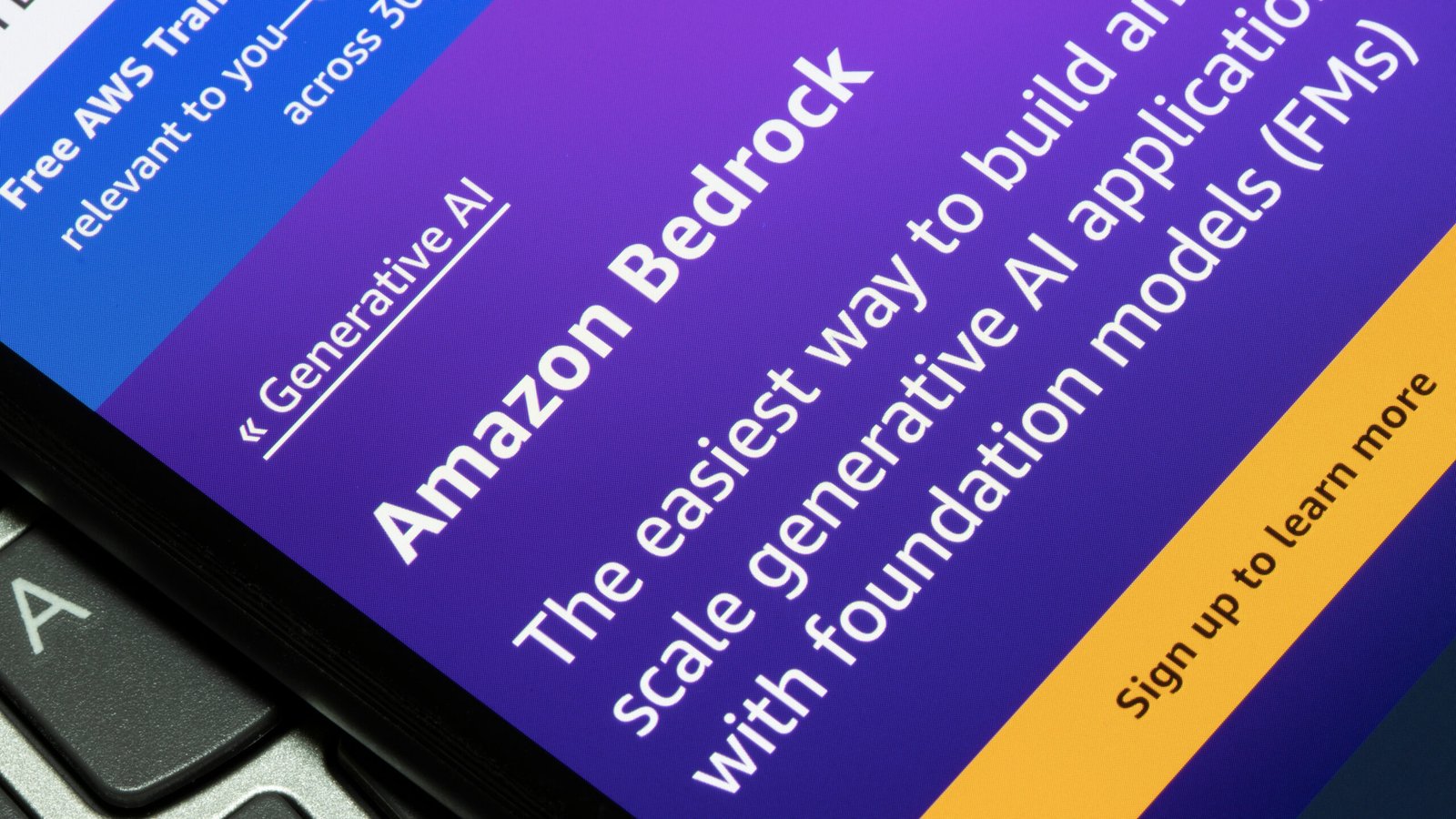
AWS late on Thursday added a new prompt optimization tool to Amazon Bedrock, its fully managed service for building, deploying, and scaling generative AI applications.
The tool, Amazon Bedrock Advanced Prompt Optimization, can be accessed through the Bedrock console, and is designed to automatically refine prompts for better accuracy, consistency, and efficiency across multiple large language models, the hyperscaler wrote in a blog post.
The tool works by first evaluating prompts against user-defined datasets and metrics, then rewriting them to optimize them for up to five inference models. It then benchmarks the optimized versions against the originals across the models to help developers identify the best-performing configurations for specific workloads, AWS said.
Currently, it is generally available across multiple AWS regions, including US East, US West, Mumbai, Seoul, Singapore, Sydney, Tokyo, Canada (Central), Frankfurt, Ireland, London, Zurich, and São Paulo.
The company said that enterprise customers will be billed for its use based on the Bedrock model inference tokens consumed during the optimization process, using the same per-token pricing rates applied to standard Bedrock inference workloads.
Will help with economics of scaling AI in production
The tool’s focus on automated prompt refinement, analysts say, will help enterprises tackle operational challenges, especially the economics around scaling generative AI workloads in production.
“Enterprise demand for such tools is being driven by a convergence of cost pressure [and] operational complexity when it comes to scaling AI, rather than any single factor,” said Gaurav Dewan, research director at Avasant.
“Inference spending is quickly becoming a board-level concern as enterprises move generative AI workloads from experimentation into production,” he said, adding that even modest improvements in prompt efficiency can have a measurable impact on operating costs when applications are running at scale.
The analyst further noted that latency is also emerging as a critical metric, particularly for customer-facing AI services where slower response times can directly affect user adoption; prompt optimization could help in that area by enabling more systematic optimization of quality, latency, and cost, rather than relying on trial and error.
In addition, said Greyhound Research Chief Analyst Sanchit Vir Gogia, the growing adoption of multi-model AI strategies by enterprises is also increasing the need for automated prompt optimization tools.
Multi-model adoption is accelerating as enterprises seek the flexibility to shift workloads across models based on cost, performance, and governance requirements, he said, adding that prompt optimization is increasingly becoming critical in ensuring applications and workflows can move between models without introducing behavioral inconsistencies or performance degradation.
Increased competition among hyperscalers
In fact, AWS is not alone in targeting prompt optimization as enterprises operationalize generative AI deployments.
Google Cloud already offers a similar prompt optimization tool in its Gemini Enterprise Agent Platform, which can automatically refine and benchmark prompts across models using evaluation datasets and metrics, while Microsoft Azure AI Foundry provides similar capabilities focused on prompt orchestration, evaluation pipelines, variant testing, and workflow benchmarking for enterprise AI applications.
That increased competition among hyperscalers, according to Gogia, reflects a broader battle over control of the enterprise AI operational layer responsible for how AI systems are evaluated, monitored, governed, optimized, migrated, secured, and managed at scale.
In his view, AWS is positioning Amazon Bedrock as that operational layer by combining multi-model access with prompt optimization, evaluation, migration support, and governance capabilities.
Meanwhile, the Gemini Enterprise Agent Platform (formerly Google Vertex AI) is leveraging its AI and analytics ecosystem, Microsoft Azure AI is integrating AI governance into enterprise software workflows, and OpenAI and Anthropic are strengthening developer-centric evaluation and prompt tooling tied closely to their own model ecosystems, Gogia said.
At the same time, he added, platforms such as Databricks and Snowflake are embedding AI observability and governance closer to enterprise data environments, while frameworks like LangSmith and open-source tools such as Promptfoo are appealing to enterprises seeking greater portability and model neutrality.
Go to Source
Author: