
Buyer’s guide: Comparing the leading cloud data platforms

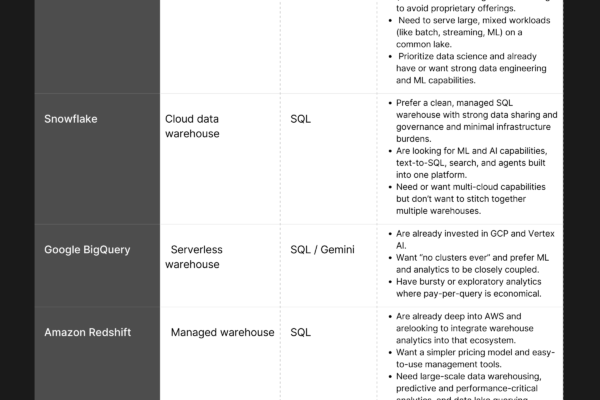
Choosing the right data platform is critical for the modern enterprise. These platforms not only store and protect enterprise data, but also serve as analytics engines that source insights for pivotal decision-making. There are many offerings on the market, and they continue to evolve with the advent of AI. However, five prominent players — Databricks,…

Read More

The best new features in MariaDB

MariaDB may have started as a MySQL fork, following Oracle’s acquisition of MySQL, but with time it’s charted its own path. Over the last few major revisions, the open source RDBMS has added unique functions, greater compatibility with MySQL, and a suite of behaviors designed to make it a migration target for Oracle SQL users….

Read More

How to adapt your skills for AI-driven development

Today, it is nearly impossible for anyone in a software development role to avoid AI technology. That’s not a bad thing; individuals and teams can realize numerous potential benefits from AI-driven development. One thing is certain: Software developers who haven’t already done so must adapt their skills to meet the demands of this new era….

Read More

WebMCP API extends web apps to AI agents

World Wide Web Consortium (W3C) participants including Google and Microsoft have launched the WebMCP API, a JavaScript interface that allows web applications to provide client-side “tools” to AI agents. The API would enable agents to interact directly with web pages and participate in collaborative workflows with human users within the same web interface. WebMCP is…

Read More

The cure for the AI hype hangover

The enterprise world is awash in hope and hype for artificial intelligence. Promises of new lines of business and breakthroughs in productivity and efficiency have made AI the latest must-have technology across every business sector. Despite exuberant headlines and executive promises, most enterprises are struggling to identify reliable AI use cases that deliver a measurable…

Read More

The death of reactive IT: How predictive engineering will redefine cloud performance in 10 years

For more than two decades, IT operations has been dominated by a reactive culture. Engineers monitor dashboards, wait for alerts to fire and respond once systems have already begun to degrade. Even modern observability platforms equipped with distributed tracing, real-time metrics and sophisticated logging pipelines still operate within the same fundamental paradigm: something breaks, then…

Read More

10 essential release criteria for launching AI agents

NASA’s launch-a-rocket activity includes 490 launch-readiness criteria to ensure that all ground and flight systems are prepared for launch. Having a launch-readiness checklist ensures that all operational and safety systems are ready, and validations begin long before the countdown on the launchpad. The most advanced devops teams automate their release-readiness checklists in advanced CI/CD pipelines….

Read More

AI-augmented data quality engineering

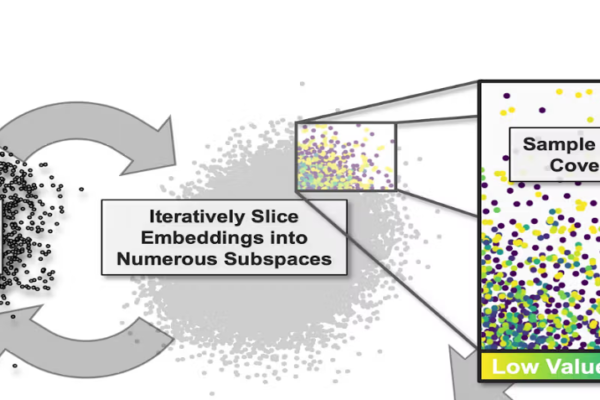
Why traditional data quality is no longer enough Modern enterprise data platforms operate at a petabyte scale, ingest fully unstructured sources, and evolve constantly. In such environments, rule-based data quality systems fail to keep pace. They depend on manual constraint definitions that do not generalize to messy, high-dimensional, fast-changing data. This is where AI-augmented data…

Read More

Python everywhere—but are we there yet?

How does Python’s new native JIT stack up against PyPy? Is there life for machine learning applications outside of Python? And can we run our Python apps in WebAssembly yet? Keep reading for answers to these and other burning questions from the Python develop-o-sphere. Top picks for Python readers on InfoWorld CPython vs. PyPy: Which…

Read More

Databricks adds MemAlign to MLflow to cut cost and latency of LLM evaluation

Databricks’ Mosaic AI Research team has added a new framework, MemAlign, to MLflow, its managed machine learning and generative AI lifecycle development service. MemAlign is designed to help enterprises lower the cost and latency of training LLM-based judges, in turn making AI evaluation scalable and trustworthy enough for production deployments. The new framework, according to…

Read More