




From Pipelines to Platforms: Google’s Data Strategy at Cloud Next 2026

The last decade of data infrastructure was built around pipelines. Move the data, transform it, store it, then do something useful with it. That approach became so normal that most teams stopped questioning it.  At Cloud Next 2026, Google seemed to be leaning toward a different way of working with data, one built more around…

Read More

The Modern Data Stack Was Never Built to Make Decisions

I was in a meeting recently with a VP of Data at a mid-size enterprise when she said something that stopped me. We were talking about her team’s quarterly roadmap, and she paused and said, almost to herself: “We have faster pipelines than we’ve ever had, and somehow decisions still take a week.” She wasn’t…

Read More

dbt Labs Report: 72% of Data Teams Use AI. 71% Fear Bad Data. Data Systems Can’t Keep Up

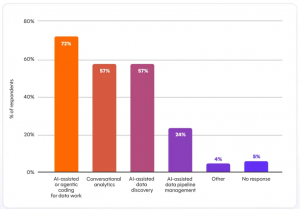
According to the State of Analytics Engineering 2026, the modern data stack is scaling fast, but unevenly. It is also growing faster than the trust and governance mechanisms designed to support it. AI is no longer experimental. It is embedded. 72% of teams now prioritize AI-assisted coding, and more than 77% of leaders are already…

Read More

Real World Lessons On Reliable Data Movement At Global Scale

Moving large-scale data across platforms, clouds, and global regions is no longer a special project for a few highly technical teams. It has become a routine operational requirement for modern enterprises. Companies now run analytics in one environment, store long-term archives in another, and build applications that must pull data from multiple locations with accuracy…

Read More

What DOE’s 26 AI Challenges Reveal About Building a National Science Engine

At BigDATAwire we outlined the key data challenges that will define the Genesis Mission. There is a growing acknowledgment that scientific AI often breaks down at the data layer. Fragmented datasets and uneven metadata introduce friction that no model alone can overcome. Federated access rules and mismatched computing environments add to the challenge. While the…

Read More

Why Real-Time Became the Default — and How Data Teams Are Actually Using It

Until recently, most enterprises treated real-time data as something you reached for only when absolutely necessary. It sat at the edges of enterprise architecture. However, that has changed. If you have been following our coverage at BigDATAwire, you would have seen that real-time data and analytics has been a core theme for enterprise modernization efforts…

Read More